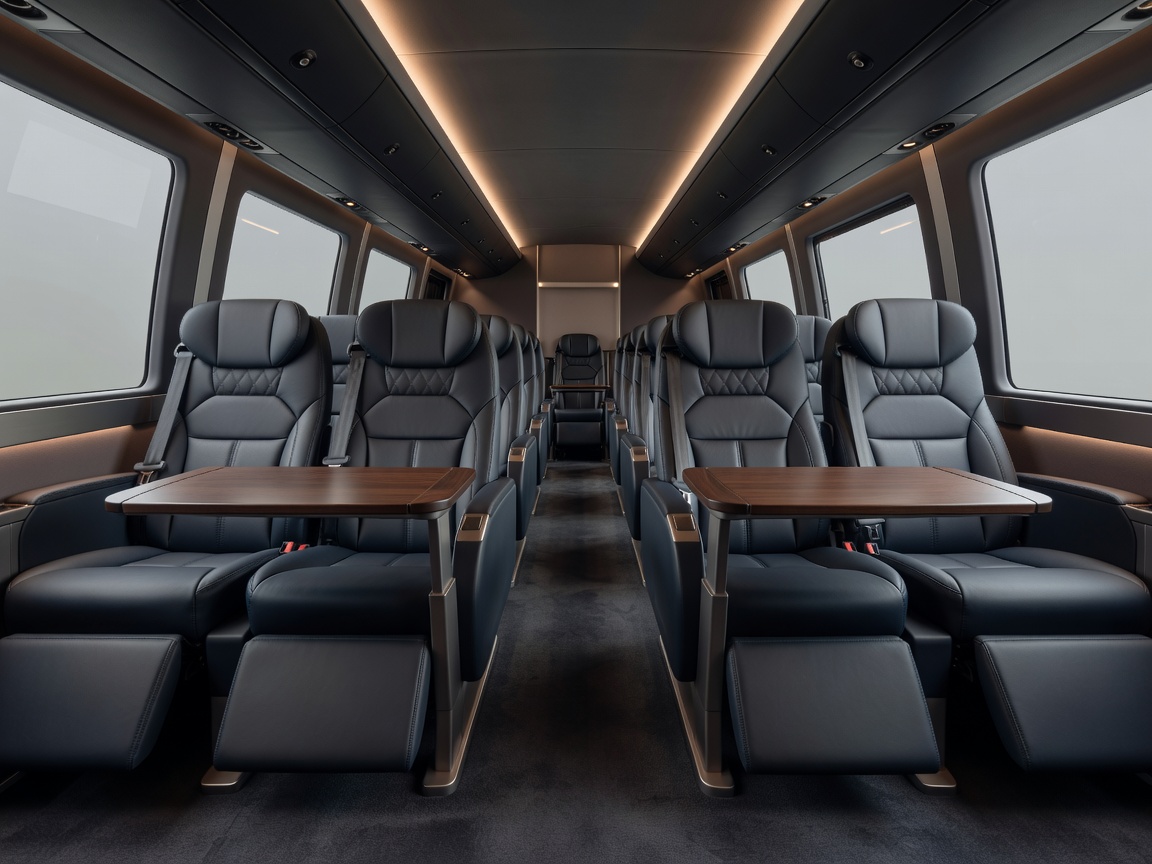
Custom low-density interior configuration: 30 executive recliners replacing standard 54-passenger layouts to ensure proper athlete hamstring recovery.
1. Ergonomics and Seating Geometry for Elite Athletes
Standard continental luxury coaches typically seat between 49 and 57 passengers on a 13-meter three-axle chassis. For an elite squad comprising football, rugby, or basketball athletes, this layout is fundamentally unsuitable. A 6-foot-4 athlete seated in a conventional 72-centimeter seat pitch experiences continuous hip flexion and restricted peripheral circulation over four- to six-hour road journeys.
In professional camp mobilization, coaches must be specified in a "VIP Sports Layout," reducing seat capacity to 28–32 seats. This expands the seat pitch to a minimum of 95–110 centimeters, providing adjustable calf supports, flat recline capability, and fold-out workstations for tactical review. Club medical staffs consistently mandate that travelling squads avoid stationary leg confinement immediately before or after heavy physical training blocks.
2. On-Board Technology, Recovery, and Power Provisioning
Modern camp transit relies on continuous operational and physical support while en route. We prioritize coaches equipped with three distinct technical elements:
- Isolated 230V High-Draw Circuits: Beyond standard USB ports, the coach must support active pneumatic compression boots (Normatec/Compex systems), refrigerated storage for protein and electrolyte supplements, and video analysis projection units.
- Multi-Zone Climate Management: Athletes generate high metabolic heat post-training. Systems must maintain an internal ambient temperature of 18°C – 20°C regardless of external summer conditions across the Rhône Valley or Po Plain.
- Medical Stretcher Berth Provision: At least one rear seating bank must convert to a flat examination platform or resting cot for an athlete dealing with acute soft-tissue trauma sustained during pre-camp fixtures.
Key Takeaway: Dual-Driver Requirement
EU Regulation (EC) No 561/2006 strictly limits driver operations to 4.5 hours of continuous driving, with mandatory daily rest requirements. For cross-Europe journeys (e.g., Munich to Lake Garda, or Lyon to the Austrian Tyrol), routing with dual drivers prevents mandatory 45-minute highway standstill intervals that disrupt squad meal schedules and sleep chronobiology.
3. Vehicle Fleet Comparison: Single-Deck VIP vs. Double-Decker
Selecting the ideal chassis configuration requires balancing athlete segregation with luggage capacity. The table below illustrates the operational trade-offs evaluated during our route design phase.
| Evaluation Criterion | Super-VIP Single-Deck (13m) | Custom Double-Decker (14m) |
|---|---|---|
| Athlete Capacity | 28 – 30 Executive Recliners | 42 – 50 Split-Deck Seats |
| Underfloor Luggage Volume | 11.5 – 13.0 m³ | 6.5 – 8.0 m³ (Reduced by lower deck lounge) |
| Staff/Athlete Separation | Single open cabin; quiet-zone partitioned | Full physical separation between upper/lower decks |
| Alpine Road Clearance | Superior maneuverability; standard height clearance | Restricted on certain secondary alpine passes and tunnels |
| Tactical Meeting Capability | Overhead displays; row-by-row audio | Dedicated 8-seat meeting table suite on lower deck |
4. Support Vehicle Integration and Van Chimes
A common logistical error is overloading the primary team bus with training equipment, leaving insufficient room for athlete personal bags. We deploy a synchronized "chaser van" or mid-size freight Sprinter dedicated exclusively to overflow baggage, kit manager crates, and immediate pitchside equipment.
This support vehicle operates thirty minutes ahead of the primary coach. The advance vehicle arrives early at the camp hotel, coordinates security gates, offloads medical treatment beds into the team physiotherapy suite, and arranges room keys at reception before the athletes disembark from the main coach.
5. Route Execution and Driver Briefing Protocols
Drivers servicing European athletic camps must undergo sports-specific briefings. Unlike tourist charters, sports teams require uniform speeds to avoid jerky braking, precise arrival timing coordinated with hotel catering kitchens, and absolute discretion regarding squad conversations and training schedules.