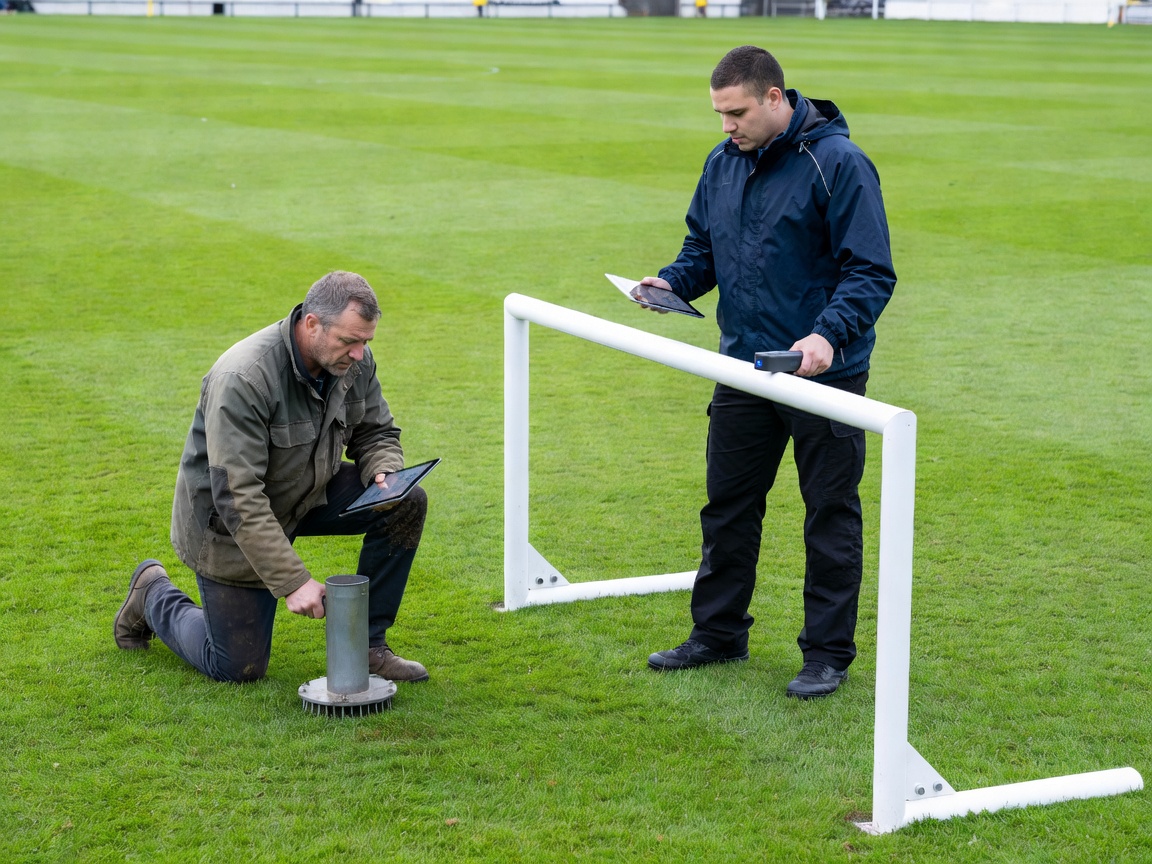
Pre-camp surface audit: Clegg hammer testing for surface traction and root-zone moisture before team arrival.
1. Pre-Camp Ground Audits and Turf Readiness
When a team arrives at an external European facility—whether a regional community stadium in Bavaria or a specialized sports academy in Andalusia—the surface condition is often unpredictable unless physically verified. Training on pitches that are either overly compacted or excessively soft increases muscle fatigue and soft-tissue injury risk during intense double-session camp periods.
Our logistics protocol mandates an on-site ground inspection ten days before squad mobilization:
- Surface Hardness Testing: Utilizing standardized Clegg Impact Soil Testers or 2.25kg drop hammers to ensure readings fall within the target 70–90 gravities (gmax) acceptable for elite play.
- Mowing and Irrigation Calibration: Establishing grass blade cut heights (typically 21–23mm for elite European football) and scheduling automated sprinkler cycles 45 minutes prior to session kickoffs.
- Goal and Boundary Dimensions: Checking sub-frame stability, post anchoring, net tensioning, and millimeter-precise line marking using non-toxic paint formulations.
2. Pitchside Technical Zone and Recovery Staging
The perimeter surrounding the training field must function as an operational annex to the locker room. We engineer dedicated field zones:
- GPS & Telemetry Command Tent: A shaded, weather-protected marquee fitted with 230V clean power and high-speed Wi-Fi backhauls, allowing sports scientists to monitor live physiological outputs without sun glare on field laptops.
- Cold-Water Immersion (CWI) Station: Deploying portable inflatable cryo-tubs or rigid fiberglass pools directly adjacent to the tunnel exit. Logistics manages water intake hookups, hygienic filtration, and daily delivery of 200–400 kg of crushed block ice to maintain water temperatures strictly between 10°C and 14°C.
- Emergency Medical Egress Lane: Ensuring an uninterrupted, 3.5-meter-wide clearance corridor directly from the sideline to the public roadway for ambulance access, with dedicated keys to locked stadium perimeter gates held by the logistics lead.
Perimeter Privacy and Media Security
Preseason and mid-season camps frequently involve closed-door tactical rehearsals and set-piece installations. We install rapid 2.2-meter acoustic and blackout geotextile screens across chain-link fences surrounding the venue, preventing unauthorized observation or drone footage from public perimeters.
3. Daily Movement Coordination: Hotel to Training Pitch
The daily shuttle between team accommodation and training grounds must operate with strict military precision. A three-minute delay at an automated parking barrier can throw off warm-up schedules and pre-activation routines.
| Time Window | Operational Action | Responsible Unit | Verification Gate |
|---|---|---|---|
| T minus 90 min | Advance Van arrives at pitch; hydration/GPS set up | Kit & Freight Lead | Ice pools filled; balls inflated to 0.85 bar |
| T minus 45 min | Turf irrigation cycle 1 initiated | Venue Grounds Team | Even surface dampness confirmed |
| T minus 20 min | Primary Team Coach departs hotel with traffic escort | Transport Coordinator | Green corridor routing active |
| T minus 5 min | Coach arrives at designated tunnel bay | Site Logistics Officer | Direct sterile walkway into locker room |
| T plus 105 min | Session concludes; cold-water plunge & kit collection | Medical & Kit Staff | Immediate wet-kit segregation for laundry |
4. Utility, Water, and Waste Management
Training facilities in rural or mountainous areas often lack the utility capacity demanded by modern sporting delegations. A squad of forty athletes and staff running laundry machines, ice makers, and multiple treatment devices can trip local breaker panels.
We deploy mobile diesel generators or auxiliary three-phase distribution boards where municipal infrastructure is insufficient. Furthermore, daily laundry requires commercial 18kg washers operating at 60°C cycles to satisfy hygienic sports directives, often sourced through contracted regional industrial laundries when site capacities fall short.
5. Camp Tear-Down and Post-Camp Restitution
Upon camp completion, returning the training facility in pristine condition is vital for preserving venue partnerships. We execute an exhaustive post-camp walk-through: divot repair, perimeter screen removal, temporary partition dismantling, and municipal waste clearance, leaving the ground immediately ready for local community use.